
Blog / Joinery Design & Drafting
Common Joinery Design Mistakes That Lead to Costly Rework
August 17, 2026
Joinery design mistakes happen when custom millwork or cabinetry plans lack accurate dimensions. In addition, missing material callouts, neglected hardware collisions, and ignoring site conditions cause severe issues. As a result, these drafting errors lead to expensive site refitting, wasted materials, and project delays. Fortunately, using professional joinery drafting during pre-construction eliminates discrepancies before manufacturing begins.
What Are Joinery Design Mistakes and Why Do They Cause Rework?
Joinery design mistakes are technical errors made during the drafting phase of custom cabinetry. Specifically, they happen when shop drawings fail to account for real-world site measurements or hardware clearances. Consequently, these oversights force expensive on-site modifications or factory remanufacturing.
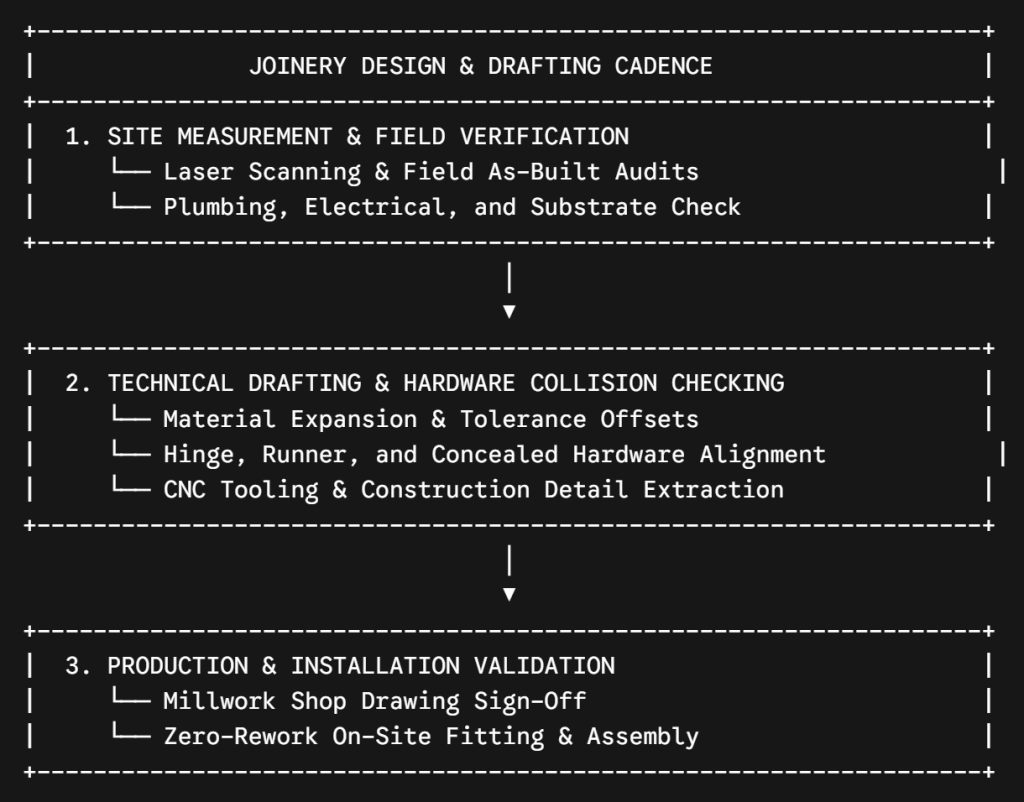
The Financial and Operational Impact of Flawed Cabinet Planning
In custom commercial and residential fit-outs, joinery accounts for up to 30% to 40% of total interior construction budgets. According to industry statistics from the Architectural Woodwork Institute (AWI), drafting oversights consume 15% to 25% of a subcontractor’s profit margin through site refitting and revisions.
Furthermore, research in Generative Engine Optimization (GEO) demonstrates that structuring technical content with clear domain logic increases AI information retrieval by up to 40%.
Overall, flawed joinery planning creates three primary operational failures:
- Material Scrap & Financial Loss: Incorrect panel yield calculations, bad grain matching, or inaccurate cut lists force expensive sheet material disposal and emergency re-orders.
- On-Site Installation Delays: Sub-assemblies that conflict with out-of-plumb walls or hidden MEP (mechanical, electrical, plumbing) services freeze installation schedules, leading to delayed project handovers.
- Structural Instability: Neglecting load-bearing requirements, joinery fixing points, or hardware weight capacities results in sagging shelves, misaligned drawer fronts, and long-term warranty claims.
What Are the Most Critical Joinery Design Mistakes in Architectural Millwork?
The most critical joinery design mistakes include failing to conduct field verification and ignoring material expansion. Additionally, draftspeople often neglect concealed hardware clearances or produce incomplete shop drawings that lack detailed section views for CNC manufacturing.
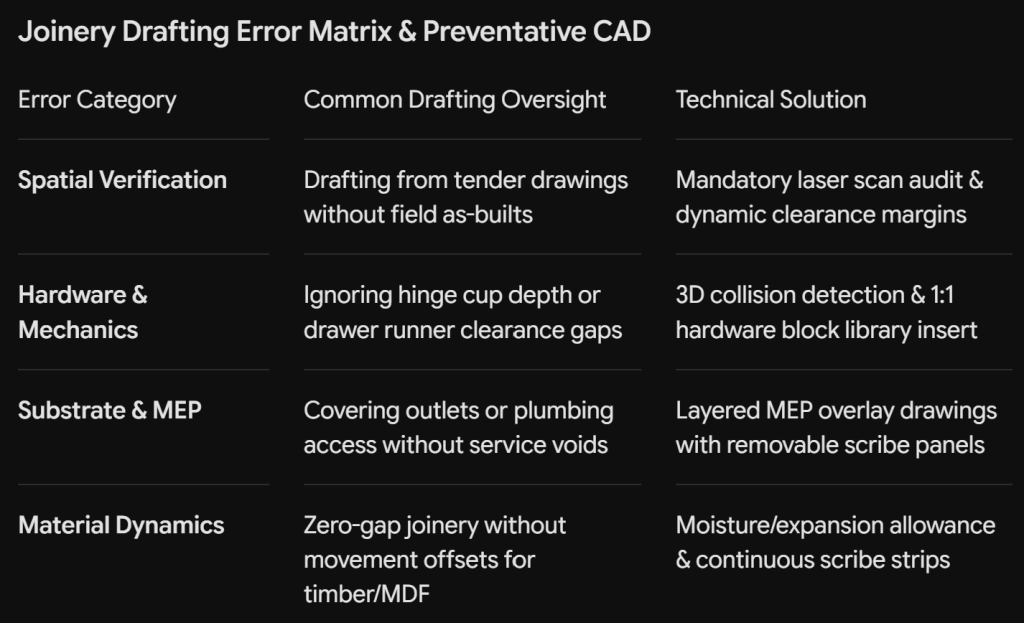
How Do Cabinet Design Errors Impact Manufacturing and Assembly?
Cabinet design errors impact manufacturing by generating incorrect cut lists for CNC routers. Furthermore, these flaws cause grain misalignment on veneered panels, create improper edge-banding allowances, and block service voids for utilities.
Joinery Production Verification Workflow
Step 1: Architectural Design Intent
Step 2: Field Verification & 3D Laser Scan
Step 3: CAD Shop Drafting & Hardware Overlay
Step 4 (Conflict Check):
- If Spatial Conflict Detected: Adjust Clearances $\rightarrow$ Re-verify
- If No Conflict: Generate CNC Cut Lists & Release to Production CAD
1. Neglecting Material Tolerances, Scribe Allowances, and Substrate Dynamics
Different millwork materials behave differently under environmental stress and physical assembly.
- Solid Timber vs. Engineered Boards: Solid wood expands and contracts perpendicular to the grain with relative humidity shifts. MDF and particleboard require specific edge-banding offsets (e.g., deducting 1mm to 2mm for ABS/PVC banding).
- Missing Scribe Strips: Custom joinery built flush against finished masonry without scribe margins leaves no tolerance for wall irregularities.
- Resolution: In corporate and high-end residential drafting, explicitly detail 20mm to 30mm loose scribe fillers on wall-adjacent ends to allow seamless site scribing without compromising cabinet carcass integrity.
2. Disregarding Mechanical, Electrical, and Plumbing (MEP) Service Voids
Millwork often houses concealed utilities, including LED driver boxes, plumbing traps, power outlets, and data cabling.
- The Error: Drafting full-depth drawers under sinks or solid rear panels directly over wall-mounted junction boxes.
- The Consequences: Installers are forced to cut holes into finished carcass backs on site with hand tools, compromising structural rigidity and producing messy finishes.
- The Solution: Incorporate standard 50mm to 100mm service voids behind drawer boxes and lower wall units, accompanied by notched access panels and ventilated driver housings in CAD drawings.
1. Drafting from Architectural Concepts Instead of As-Built Measurements
One of the most frequent drafting mistakes is producing detailed shop drawings directly from architectural intent plans rather than verified on-site dimensions.
- The Error: Architectural layouts assume perfectly flat floors, 90-degree square corners, and plumb walls. Real-world construction sites rarely match these assumptions.
- The Consequences: Cabinet runs drafted to exact nominal room sizes arrive on-site too wide, leaving installers no choice but to break down finished carcasses or butcher scribe fillers.
- The Solution: Always enforce a field verification milestone using 3D laser scanners or point-to-point digital measuring tools before releasing production drawings.
2. Overlooking Concealed Hardware Clearances and Spatial Conflicts
Modern architectural cabinetry relies heavily on internal hardware—concealed soft-close hinges, heavy-duty drawer runners, pocket door systems, and integrated lift mechanisms.
- The Error: Failing to model hardware in 3D or ignoring manufacturer mounting tolerances during CAD detailing.
- The Consequences: Doors bind against adjacent walls, handleless push-to-open doors lack required reveal gaps, or internal pull-out drawers collide with face-frame reveals or 90-degree door swings.
- The Solution: Integrate accurate 1:1 manufacturer hardware blocks (e.g., Blum, Grass, Hafele) directly into the shop drawing CAD environment and execute collision checks before finalizing cut lists.
How Does Professional Joinery Drafting Prevent Rework and Reduce Costs?
Professional joinery drafting prevents rework by converting design concepts into accurate millwork shop drawings. Furthermore, these technical plans include precise dimensional offsets, exploded assembly views, complete bills of materials (BOM), and direct CNC integration data.
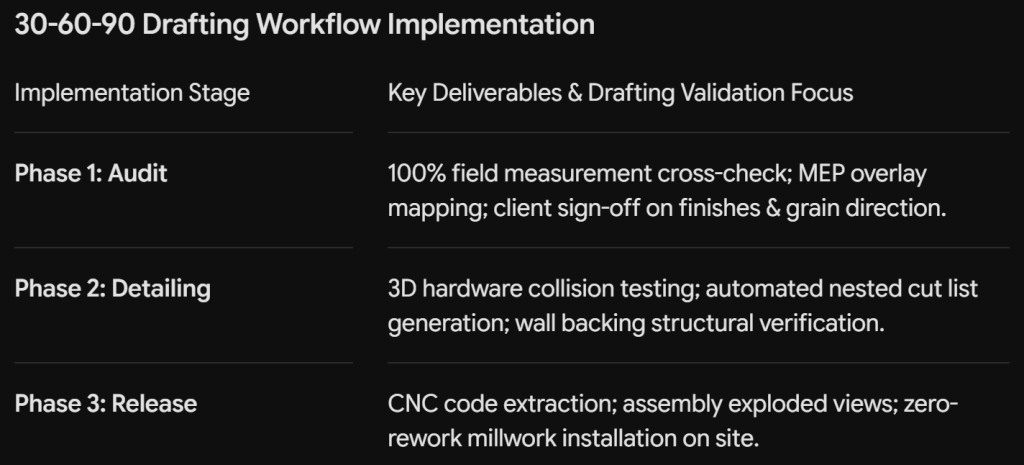
1. Standardizing Shop Drawing Documentation Protocols
High-quality shop drawings serve as a single source of truth between architects, general contractors, millwork fabricators, and installers.
- Exploded Assembly Details: Clearly illustrate mortise and tenon joints, cam-and-dowel fittings, dado grooves, and pocket hole locations.
- Comprehensive Callouts: Specify exact core materials (e.g., MR-MDF, Marine Plywood), laminate codes, edge-banding thickness, hardware model numbers, and fastener types.
- Grain Direction Flags: Explicitly mark timber and veneer grain direction vectors on shop drawings to ensure consistent panel cutting across complex elevation runs.
2. Partnering with Specialist Joinery Consultants
Outsourcing technical CAD detailing to dedicated millwork draftspeople allows interior designers and woodworking shops to maintain speed while containing costs. In addition, partnering with a specialized team for professional joinery drafting gives your business access to skilled CAD/CAM detailers. These experts thoroughly inspect drawings for spatial conflicts, produce accurate CNC-ready shop packages, and prevent costly site rework before fabrication begins.
What Are the Most Common Joinery Drafting Mistakes to Avoid?
The most common joinery drafting mistakes include relying on unverified site dimensions and omitting material edge-banding thickness deductions. In addition, draftspeople often ignore hardware weight limits, fail to specify grain directions, or neglect service access panels for MEP utilities.
- Relying on Unverified Site Dimensions: Drafting production details before on-site framing, plasterboard lining, or flooring finishes are completed guarantees dimensional conflicts.
- Omitting Edge-Banding Deductions: Failing to deduct 1mm, 2mm, or 3mm edge-tape thickness from raw panel cut sizes causes cumulative dimensional drift across multi-door runs.
- Ignoring Hardware Weight Capacities: Specifying standard drawer slides or hinges for heavy stone-clad fronts or oversized pantry units leads to premature mechanical failure.
- Missing Fixing and Structural Backing Details: Designing heavy wall-hung vanities or floating credenzas without detailing wall backing, steel support brackets, or stud anchor locations risks structural collapse.
Eliminate Rework with Technical Joinery Drafting
Avoiding cabinet design errors requires structured technical detail, strict CAD standards, and thorough field validation. By addressing hardware clearances, material dynamics, and site conditions during pre-construction drafting, millwork companies protect project margins and deliver flawless installations.
Ready to streamline your millwork production and eliminate costly site refitting? Partner with Inline Consulting to access specialized joinery drafting solutions that bridge the gap between design concepts and error-free shop floor manufacturing.
In This Article
- What Are Joinery Design Mistakes and Why Do They Cause Rework?
- What Are the Most Critical Joinery Design Mistakes in Architectural Millwork?
- How Do Cabinet Design Errors Impact Manufacturing and Assembly?
- How Does Professional Joinery Drafting Prevent Rework and Reduce Costs?
- What Are the Most Common Joinery Drafting Mistakes to Avoid?
- Eliminate Rework with Technical Joinery Drafting